

| Click here to download pdf version | |
| Functional movement, or the ability to move and respond without restriction, as well as to move and respond effectively and with intention, begins with an understanding of core stabilization and neutral spinal posture. | |
| core stabilization and its importance to functional movement | |
| Obviously, the ability to position the spine and activate the muscles necessary to do so is a key skill as it relates to all movement. Equally important, is training the core with the understanding that it links upper and lower body movement. Putting the importance of alignment skill and integrated movement capability in perspective requires a brief discussion of 1) the “serape effect,” 2) the impact of load, 3) abdominal bracing, as well as, 4) the development of a definition for core training that aligns with functional training. | |
| the serape effect | |
| The serape effect, first described by Logan and McKinney (1970) helps one to visualize what the core musculature is anatomically suited to accomplish, especially as it relates to rotational power development. The serape is a scarf-like blanket worn by natives in some areas of Mexico and South America. It drapes around the neck and shoulders and crosses near the waist, tucking into the belt area. Visualizing how the serape is worn captures the functional design of the torso muscles' crisscrossing nature. In essence, how the serape is worn reflects fiber direction of the torso muscles, which in turn determines muscle function and movement capability. Most of the muscles of the core/ torso and their associated fiber directions are oriented in horizontal or diagonal directions. This anatomical design lends itself well to rotational force production between the hip and opposite shoulder, especially when coupled with ankle, knee and hip extension movement. The so called serape effect (Logan and McKinney, 1970) is specifically the result of interaction between the rhomboids, serratus anterior, and the external and internal obliques. | |
![]() |
|
|
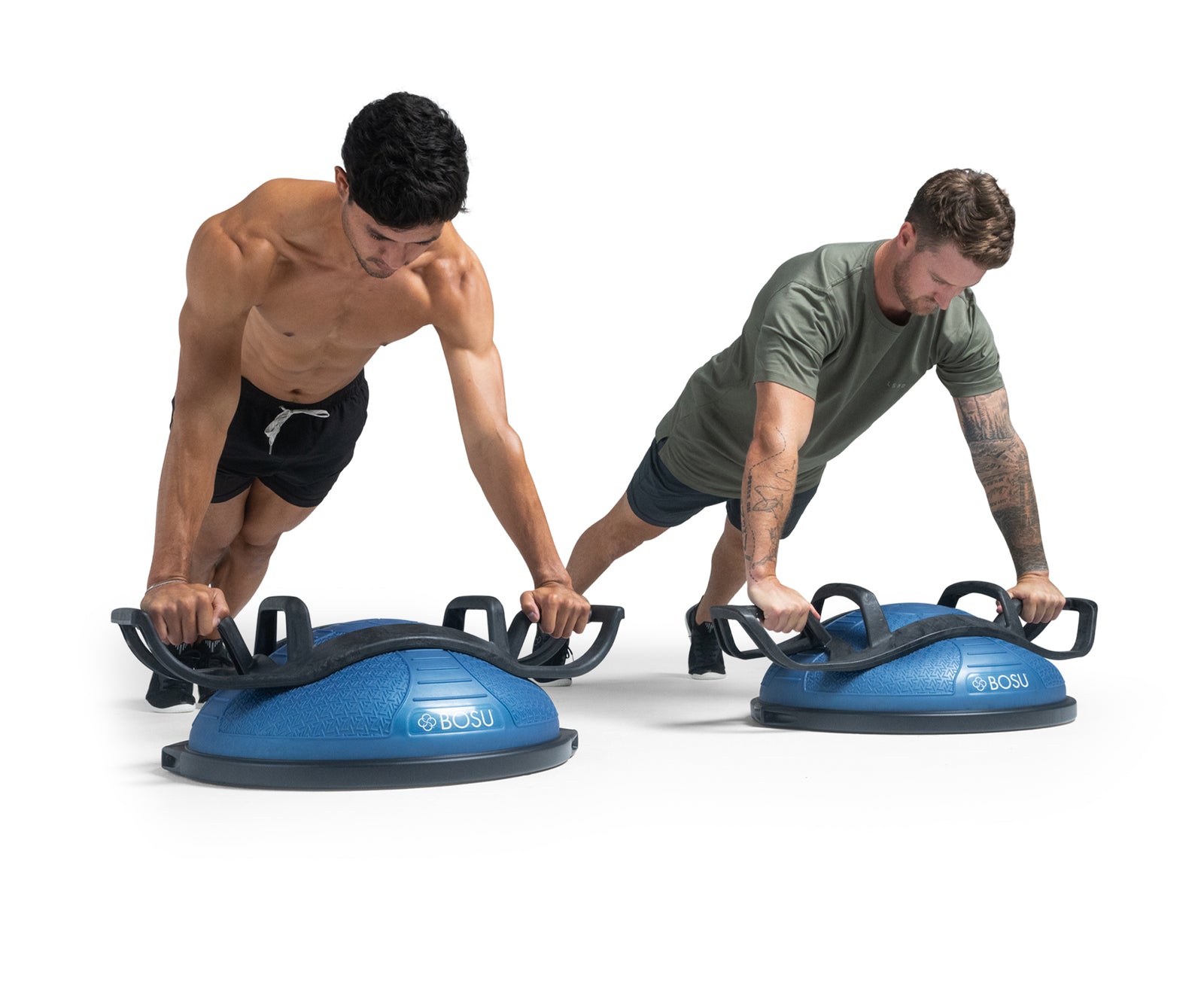
Based on this functional model, it becomes obvious that useful core/torso training must be more involved than, for example, training the rectus abdominis with isolated trunk flexion and the torso with barbell chest presses. Note that Logan and McKinney made this observation in 1970, yet integrated core and torso training has not been universally received or implemented, though understanding and use of functionalintegrated training is gaining momentum. All of the BOSU® Programs incorporate this concept of integrated movement into exercise progression and include the BOSU Integrated Balance Training, BOSU Pro Fitness Training Series, BOSU Sport Training Series and the BOSU Balance Trainer Complete Workout System programs.
Being able to establish a braced spine and maintain a braced core is essential to effective and safe movement. This is accomplished by maintaining a mild contraction or tension in the abdominal wall. However, abdominal bracing is very different than abdominal hollowing, which generally refers to a pulling or drawing in of the abdominal wall. When the bracing is performed correctly no change occurs in the abdominal wall. McGill (2002) refers to this as muscle stiffening and terms it “abdominal bracing.”
With this background in mind, Richardson and colleagues also observed that transversus abdominis recruitment is impaired after injury. Therefore, Richardson's group developed a reeducation program of exercise to activate this muscle group in low back patients. However, McGill (2002) points out that this is misguided because hollowing as a reeducation exercise for this particular muscle does not ensure stability. Therefore, to encourage back patients or athletes to use hollowing over abdominal bracing if the goal is to enhance stability when performing daily activities and sport is mistaken. Abdominal bracing activates three layers of the abdominal wall (transversus abdominis, internal oblique, external oblique) with no added motion of drawing in, and is much more effective at improving spinal stability (McGill 2001; McGill 2002). teaching abdominal bracing Teaching abdominal bracing, as is true for teaching neutral posture, is challenging. An instructor is simply asking the participant to stiffen the abdominal wall with a mild isometric contraction, where no movement occurs in the spine or pelvis. If a participant can already establish neutral posture and can differentiate hip flexion from spinal flexion and extension, he/she will be ready to combine these skills with abdominal bracing. A trainer or instructor should teach that abdominal bracing occurs when the abdominal wall is neither sucked in nor pushed out. McGill (2002) suggests communicating this idea of bracing by having the person stiffen one joint, such as the elbow, by simultaneously contracting the flexors and extensors. The person stiffens the joint without any movement occurring at the joint and palpates the joint to feel what is happening. This can be practiced at other joints like the knee. Then, the drill is moved to focus on the core/torso region and the person uses the same technique to achieve the bracing effect. Finally, an instructor can teach the participant to maintain the abdominal brace during functional movement situations that include picking up a child, moving in and out of a chair, or during an explosive athletic movement. We often refer to this involved bracing concept as “setting” the core. Realize that stiffness of the core might be sustained for a period of time or only needed on and off for brief moments during performance. But, to set the core correctly, regardless of the situation, one must understand all of the ingredients that contribute to effectively creating optimal core stability.
|
|